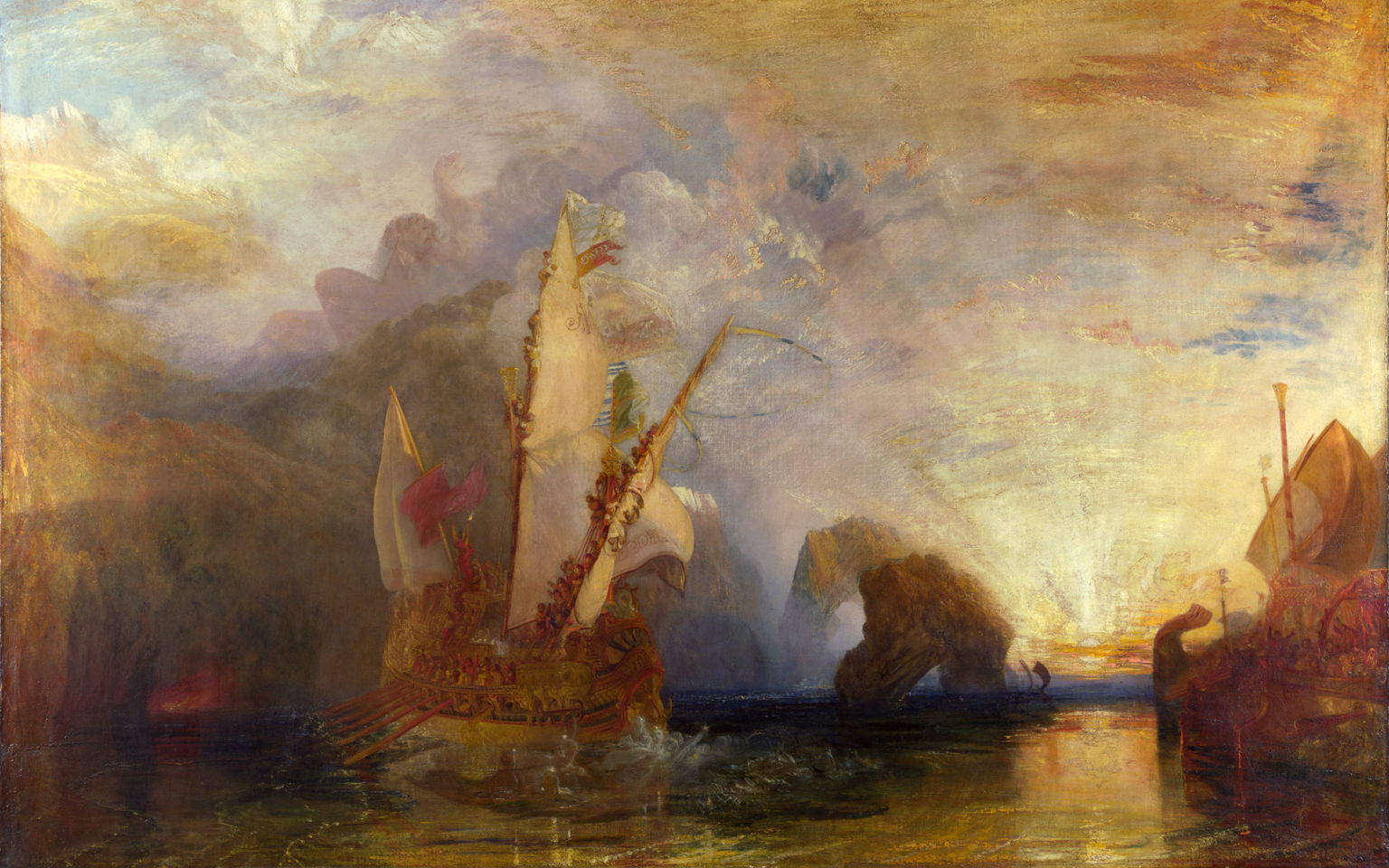
“Make the tale live for us
In all its many bearings,
O Muse.”
— Homer
I am falling woefully short on my reply to Europe 2031, as it seems that there is more to say than I initially thought. I am tired. Sometimes, it is best to just lean back and stare at the wall and cast on its chalky flatness the shadows of your mind’s blaze. Having said that, I want to cement a stray thought — one that keeps bubbling up — that I had at about 9,000 meters above terra firma (I find the air much less firm) on less than four hours of sleep, just as the “rosy-tinted fingers of dawn crept up the sky.”
I have recently picked up again The Odyssey, partly as an excuse to hype up what Nolan will butcher, partly because I own a version from Macmillan Collector’s Library, masterfully rendered in stupendous British English by T. E. Lawrence. I am not reading it for its translation prowess — as I am, for instance, with Sarah Ruden’s Gospels — but for its vividness. My British English is not that strong vocabulary-wise, but even I can tell there’s no finer literary English than British English.
Anyway, Odysseus’ destiny was to return home. While that may not strike the modern man as an elevated endeavor, it goes to show how even the most prosaic desires, when engaged with zeal and grit, can turn one into a hero.
You do not have to be familiar with the Odyssey — nor the Iliad — to appreciate the subtleties of an 8th century BCE craftsman. You see, the Odyssey is a deliberate inversion of the Iliad. In the Iliad, Achilles is offered a choice not unlike Thanos’ perfectly balanced knife parable Gamora took in, and he picks glory (kleos) and a short life at Troy over a long, obscure one at home. Odysseus makes the opposite choice — he longs for homecoming (nostos). The long story short is that the poem argues that the latter is the harder, worthier heroism. Anyone can want to be remembered, but wanting to get back to an ordinary life — and being willing to suffer ten years for it — is a rarer virtue.
What is it like to be Odysseus?
The poem tells us. Odysseus fought a war among his brotherhood, and yet the foes he faces on his way back home are temptations to stop him from wanting to get there. Calypso — the nymph who detains him on Ogygia for seven years — offers him immortality; Circe — the enchantress on Aeaea who turns his men into pigs — comfort. The Lotus-eaters — the people whose island food induces dreamy forgetfulness — offer him oblivion; the sirens — the creatures whose song bestows total knowledge of everything that was and will be — omniscience . Odysseus’ show of strength is to withstand his craving.
Not unlike Achilles, his own heroic instinct becomes a turning point of his suffering. After he blinds the cyclops Polyphemus, he cannot resist shouting his true name so Polyphemus knows who blinded him. That reach for kleos brought Poseidon’s wrath on him, adding years to his journey. In the Odyssey, the habit of seeking fame is itself an act of sabotage against the homecoming. Odysseus meets Achilles’ ghost in the underworld, and upon seeing him, Odysseus flatters Achilles, now honored among the dead. But Achilles swiftly replies that he would rather be a living servant to a landless poor man than a king of the dead. Odysseus also meets Agamemnon’s ghost there — the commander of the Greek forces at Troy — who was butchered in his bath by his wife. The warning is the poem’s crafty way of saying that homecoming is yet another battlefield, far from safe harbor. And last but not least, Odysseus visits Tiresias who foretells (or maybe confirms) his future — that he is returning to a home that is itself under siege. And eventually, he does not return home as the sacker of Troy, but as a beggar. He has to endure being struck and mocked without breaking cover. Once again, we see the Homeric inversion of the heroic code: Achilles’ identity lies in public recognition, while Odysseus’ in avoiding it at the cost of his dignity. It is visceral.
And still, after all being said and done, his tribulations were not yet over. Even after the slaughter of the suitors, Odysseus must take an oar — Poseidon’s emblem — on his shoulder and walk inland — or away from the sea — until he meets people who have never seen a ship and do not know salt water. That will be his offering spot to Poseidon, honoring him at the end of his voyaging. In return, Poseidon — the god who tormented him for a decade — makes his death gentle, quietly ushering him out.
There is much more. Besides the details that I am willingly skipping, are the ones that I am in all likelihood missing out. The Odyssey is the kind of book that teaches you new things every time you pick it up.