“I let go of her hand, and she – She fills the room.”
— Egan
Books that tickle my mind deserve a dedicated section on this blog. I’ll make this a habit, starting with this one. Occasionally, I’ll reference older reviews I’ve left on Goodreads.
If you haven’t read the book and hate spoilers, stop reading. If, on the other hand, you’re interested in seeing the book through my eyes, read on.
The other day, my father-in-law dropped by. My wife told me about it just a few hours before he arrived. At some point, he called her phone, and she asked me to answer it. I did. As always, I pulled his leg, and for a few minutes, we had fun together. We ended the call when he told me he’d just left and was heading toward us. “That’s about an hour,” I murmured. He didn’t catch it, and neither did I. I went about my usual routine, quickly dialing back in and continuing to inspect Kimi’s chain of thoughts as they streamed into my terminal and converged on what looked probably approximately correct.
Eventually, I stood up, looked at my wife, and asked her, “Where’s your father? He should be close.” The next moment, her father called for her to come down. He had just arrived. I started yapping at my wife about how “fine-tuned” my internal clock was, when a sudden thought brazenly barged in and settled on a disquieting question:
Did I collapse her father?
The whole book builds on that idea in a mind-bending, often humorous, and irreversibly scintillating narrative.
I’m an active (inveterate) reader guilty of excessive marginalia. More than that, pick any book in my library and you’ll see notes of the kind, “This reminds me of that.” I can only remember what I can associate. And because I’ve been associating things from an early age, my memory is especially well-calibrated for forming anchors. This also comes in handy when I’m mnemonically indexing materials I haven’t finished reading — or haven’t necessarily read at all. Friends often ask me, “What was that X you shared?” In most cases, the retrieval is instant: I know how to find it because I know where it is.
When it comes to reading books that repay close reading, I’m a slow reader — I tend to revisit passages, move back and forth through the text, imagine counterfactuals. I’m a bibliophilic gourmand. This time, I thought it would be rewarding to visualize my reading journey. What follows is akin to a sequence diagram: on the x-axis are the book’s pages (first to last, in percent), while the y-axis traces the topics I found myself drawn to.
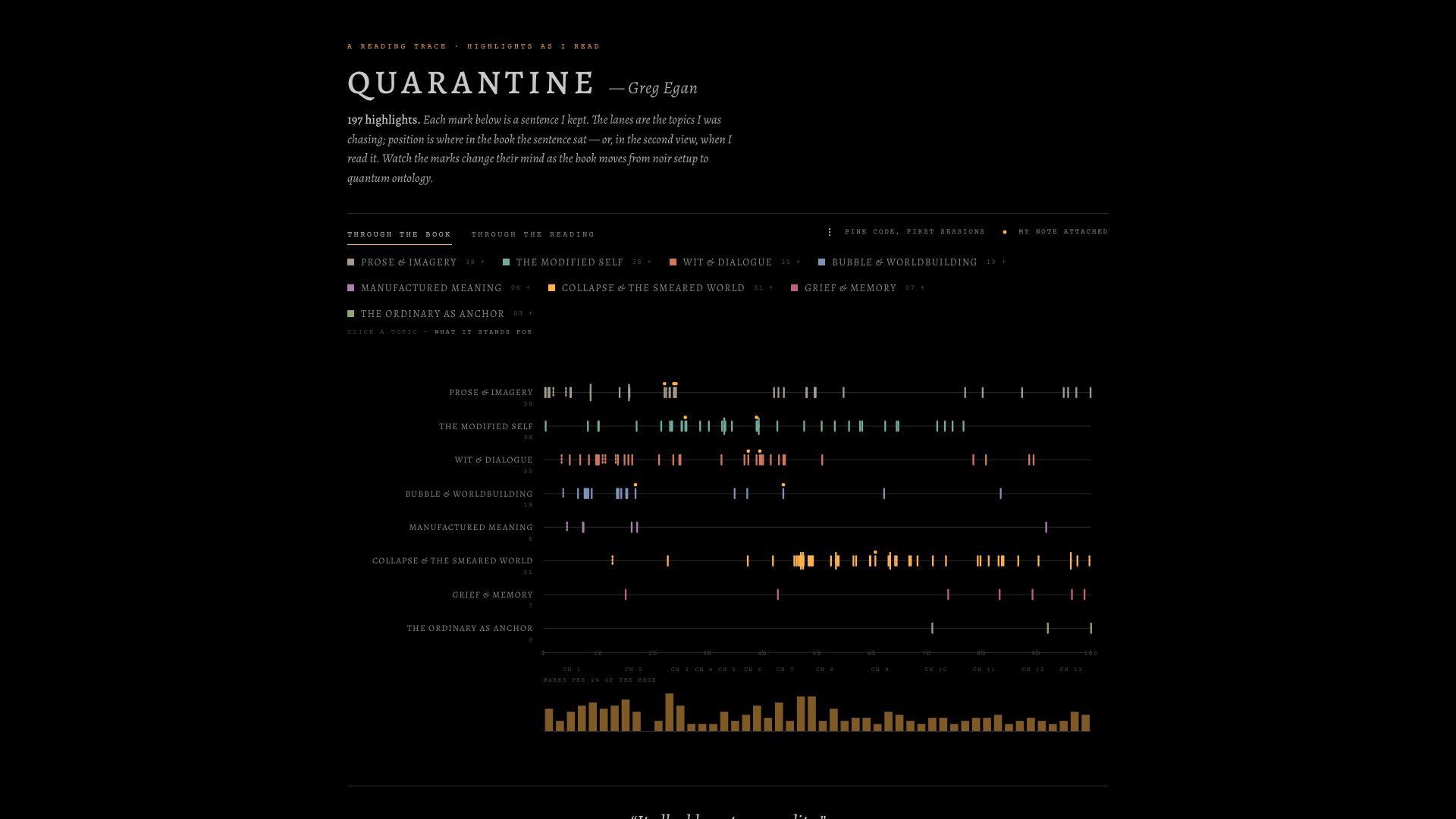
Some things immediately stand out. Prose and imagery are usually at the top of my list when I read fiction — discovering and relishing an author’s word choices opens a portal into their mind. More than that, I’m after the intricacies of the English language and the practice of articulating thought. The second obvious finding is how much I savored the physics buildup. Indeed, given the choice between sci-fi and hard sci-fi, I’ll always pick the latter. The same goes for any subject facing physics. But even that has exceptions. For instance, I had this to say about Diaspora:
I expected something different, and because of that I ended up slightly disappointed. I’m only going to focus on the story; I have nothing to say about the prose itself. Greg is a master.
One design choice I hated throughout the book was the pronoun scheme. If you’re going to do something like that, it had better be more interesting than a gimmick that constantly breaks the reading flow. It was genuinely annoying.
Anyway, the first part of the book was interesting. Then, once the physics theory kicked in—which was total bananas, and not exciting at all—it started going downhill. There were moments of brilliance, like the Wang-tile “carpet” creatures that turned out to be biological hardware running a sim which, upon inspection, contained a fully inhabited 3D space. Pretty cool.
But I feel he spent too much time on a useless physics theory, plus pages of heavy jargon describing in words what he probably plotted in Mathematica. The result was an overload of technical nonsense you had to read and half-remember despite it making little to no sense. I like thorough descriptions, but not the kind that make me epistemologically crumble.
Diaspora was… weird, almost avant-garde, like an inflection point in Egan’s narrative. Through it all, that Egan didn’t feel like the Egan who had written anything before. The quantum ontology the younger Egan explored in Quarantine was far more perplexingly alluring.
But, unlike Permutation City, whose final pages blasted me like a positron cannon aimed directly at my skull, Quarantine’s felt slightly weaker. Not bad — weaker. It didn’t go where I wanted it to go. It’s as if the plot lost its way and found home in the most boring, common place: the familiar.
And yet, we all dwell in the ordinary. The mundanity, banality, normality — a comfort life keeps reasserting through the complacency of existence at a scale too vast for guilt. If we were truly slaughtering quadrillion selves, what other comfort could we encroach upon, if not all adding up to normality? A thousand pieces in a jigsaw of beautiful mistakes.
All excerpts © Greg Egan, Quarantine (1992).