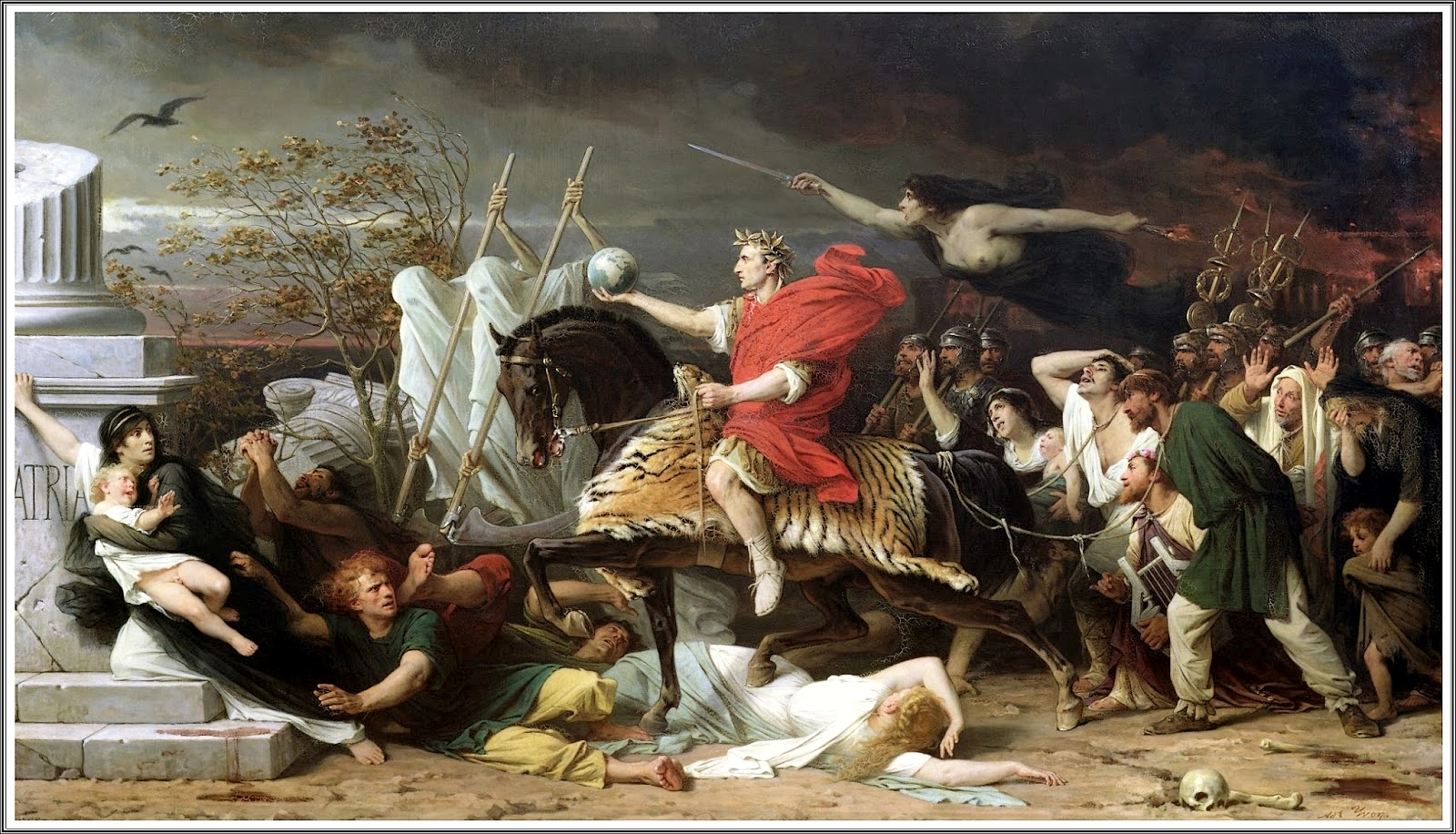
“Man is a rope, tied between beast and overman — a rope over an abyss. A dangerous across, a dangerous on-the-way, a dangerous looking-back, a dangerous shuddering and stopping. What is great in man is that he is a bridge and not an end.”
— Friedrich Nietzsche
This is part two of a two-part series. You can read part one here.
This essay is ambitious and speculative. This is about the future, a future that will outlast both of us. It stretches beyond Europe, beyond the United States, and beyond the scope of any single life.
Thymos
Every now and then, a young civilization reaches a moment of maturity at which it is compelled to ask itself: what is technology? The question is ontological, and it is addressing us. Beyond foreseeable bounds, Time reaches into the fortune cookie jar of potential history — this bundle of unrealized trajectories — to draw an ever more seductive strip and place it into the hands of Man.
This essay examines humanity’s thymos and its manifestations, whether auspicious in their promise or destructive in their consequences. One such manifestation may take the form of the engineering of godlike artifacts. The idea may appear ominous or merely foolish, yet it should not be dismissed outright.
The cover of this essay is Eugène Yvon César franchit le Rubicon. I find Caesar an inspiring historical figure, and I guess Eugène did too. When I am contemplating, I gaze at it. It is an almost bewitching depiction of what thymos is.
Caesar was a brilliant strategist, even though the painting does not make this fact evident. What we are met with instead is like a prism that brings into view the constitutive elements of light. Steadfast, Caesar is moving forward while chaos unfolds all around him. He takes the whole compositional center, and unlike his horse, which displays more empathy than he does, he does not care about displacing the crowd, bodies underfoot. The world is presented as a mere object fitting one’s hand, and already possessed. It almost looks like a gift. But a gift to whom?
To me, Caesar is neither hero nor villain in a moral sense within the painting. He is inevitability given human form. The terror around him is the price paid when one will manifests its own destiny.
From the sidewalk, today’s wills compete in a zero-sum game of flesh-and-blood proportions at precisely the moment when the forces they set in motion may be about to outpace us entirely. Is Altman’s will stronger than Dario’s? Is U.S. manifest destiny stronger than China’s? We are, Stanislaw Lem suggested, “the last relic of Nature” — a biological substrate already in the process of being transformed beyond recognition by the invasion of technology into body and environment. It is a tasteful figure of speech; we are marked as both precious and obsolete.
If you were Caesar reincarnated, how would your will bend the world? What I am about to suggest as a plausible answer will probably sound ludicrous, but you are still reading.
Immortality.
Immortality is nowhere more vividly portrayed than in great sci-fi. Two books I am returning to quite often lately are Greg Egan’s Permutation City and Roger Williams’ The Metamorphosis of Prime Intellect. If you do not enjoy reading, you could also watch Craig Silverstein’s Pantheon — it is close in spirit. Immortality’s Latinate derivative stands for a being that does not die. But, the Greek afthartos is more disquieting for what I am aiming for — flesh that does not rot. In other words, the promise — especially in Christian works such as the Gospels — is not the absence of death, but new life for a dead body, “or else a new body,” as Sarah Ruden puts it.
Why do I believe this? And when I say that, it is not something that might happen during my lifespan; it is more something that is directionally not only feasible, but worthwhile and transformative: a civilizational pursuit. Let us take a look at two contemporary figures that make this impulse concrete in very different registers — one is Brian Johnson, and the other is the Pope.
Take Brian Johnson. The public pursuit of a somewhat radical idea, even by modern standards, of life extension is not something new. The project is slightly scientific, but its appeal is chiefly charismatic. Johnson is a great performer, and because of that, his image carries vital force. From ancient times, we look up to great public performance, especially of discipline, as it invites us to participate, silently or not. Here, it is the mission of conquering death. If you are a Zoomer, he is the aura unc.
However, longevity movements always produce saints before they produce results, because the charisma does the work the data cannot yet do. He is also fighting the specific battle Tithonus lost: not dying is easy to imagine; not rotting while not dying is the soul-crushing problem, and I think that he knows it.
The Pope’s position is more complicated because he does not seem to be rejecting the technological pursuits associated with transhumanism and posthumanism as such. In fact, in his encyclical letter, Magnifica Humanitas, he argues that the Church is not opposed to technology pursuing those directions:
“From the perspective of the Church’s Social Doctrine, the key issue is not the use of technology as such, but the vision that underlies it.
[…]
We can embrace the technological progress that alleviates suffering and unlocks new possibilities, provided that we do not abandon the very essence of our humanity, namely the capacity for relationship and love.”
I would love to pick the Pope’s brain on the following arbitrary nuanced theologically inflected questions. Grace is a concept tantamount in substance, if not even more so, than faith. What if, in the end, this life is not enough for some to find or discover god, but extending it just for the right amount of time could give them a chance to receive its grace? Or what if someone wants to live forever, not for supremacy or glory, but simply to worship god? What would an immortal pope be like? Would it resemble the Genetic Dynasty, but of popes? Is this even an allowed Game Rule of Catholicism?
Frail hardware in an inhuman universe
Despite being a tremendously narrow instrument, my body is the first and last frontier of experience. Its blueprint somehow managed to endure thousands of years of adversarial pressure from a merciless environment. While calibrated for a thin survival band and living under a specific set of biospheric conditions, I can, from a medium-sized rock orbiting a regular star, describe a universe of overwhelming scale and violence. And as I am
“[s]itting there on the heather, on our planetary grain, I shrank from the abysses that opened up on every side, and in the future. The silent darkness, the featureless unknown, were more dread than all the terrors that imagination had mustered. Peering, the mind could see nothing sure, nothing in all human experience to be grasped as certain, except uncertainty itself; nothing but obscurity gendered by a thick haze of theories. Man’s science was a mere mist of numbers; his philosophy but a fog of words. His very perception of this rocky grain and all its wonders was but a shifting and a lying apparition. Even oneself, that seeming-central fact, was a mere phantom, so deceptive, that the most honest of men must question his own honesty, so insubstantial that he must even doubt his very existence.”
The likes of Alex Honnold, who scaled a 101-story skyscraper in Taiwan without any safety equipment, combined with minds like von Neumann’s, whose reach stress-test the definition of a polymath, together with all the other human beings, make up the phase space of our bodily reach. What lies beyond? It is not too hard to imagine the human body reaching Proxima Centauri, the nearest star to Earth after the sun, to expose a fatal design flaw. It would take Voyager 1, the fastest thing we have ever sent away, 75,000 years at its current pace to get there. That distance is unfathomably large. With any vessel capable of sustaining human life that we could realistically build given what we know, you are looking at a tens-of-thousands-of-years-long trip. In any vessel that we could conceivably build, it might still take several centuries.
In time, I got to know many optimists, whose standard response to such cosmic misfortunes defaults to homo sapiens characteristically not adapting themselves to hostile environments, but instead reshaping them to fit their biological necessities. I learned to spot this kind of inversion, and this one in particular has worked remarkably well on this planet, which is not entirely merciful, but predominantly docile. How poorly it scales, though, becomes glaringly obvious the moment you start contemplating the vicinity of neutron stars, or even gas giants.
And when reshaping falls short, we concoct such intricate contraptions that they become the only life support. Did you know that one astronaut in ten experiences fingernail trauma from the pressurized gloves? Or that you will lose one to two percent of your bone mineral density monthly, assuming a routine in which you exercise industriously two hours a day, six days a week? And satisfying your inner foodie’s cravings comes a distant second, with the engineered food judged by the harsher standard of whether it can still keep you alive. “A small price to pay for the view,” you could say. And I would nod.
“From the moment absurdity is recognized, it becomes a passion, the most harrowing of all.”
It is absolutely astonishing that we can do science in the cold vacuum of space. But do you notice the detail? It takes a consciousness to “be there”, not a body. I will make this less obtrusive by inviting you to partake in the following thought experiment.
You are floating in a salt pool. It is dark, and the water is just about right, at skin temperature. For a while you remember you are in the pool.
For a while.
You put a headset on through which I feed you the eyes and ears of a low Earth orbit laboratory. On your back, you slowly raise your hands, as if maneuvering something in the air above the water’s surface. You are slowly losing touch with your bodily context while engaged in teleoperating robotic arms from a remote salt pool on Earth. You are not careful enough and spill some acid over your right hand. Your arm incessantly twitches and you feel a sudden pang. But you remember you were never leaving the planet. You are in your pool and knowing that proved enough to trigger relief. But something did leave.
Signals arriving in the right patterns (or perhaps the real patterns), as far as we know, represent a brain inference that maps to a sense of having a body. If I stroke a rubber hand that is in front of you while yours is gently brushed out of sight, within minutes, you will flinch. The body transfer illusion is a well-established phenomenon. The same signals induce a lot of trickery, including quietly adopting what seems to be a “new body.” If it is not clear by now, I fall into the category of people that believe the body’s primeval duty is that of sustaining the mind and acting as an interface to the world. I am not dismissing the body, though. Bodies cultivate minds, but assuming favorable developmental conditions, every mind reaches its most elevated form, which, to me, for lack of a word, I will refer to as having noble-gas-like properties. In short, I believe strongly in embodied intelligence, but I am a doubter of this hardware.
But I will assume you are an optimist, or much less skeptical than I am. Thus, what are the flesh-bound options we have on the table? Confined to Earth, we discovered a way of thriving under this closed ecology. It feels only natural to demand the same from a generation ship aimed to function for centuries. What about the physics of interstellar travel? At one-tenth the speed of light, your ship’s hull has to endure continuous sub-micron sandblasting from contact with the interstellar medium. Scale that to a sliver below the speed of light and your clock nearly stops. “Aha, but if our clock stops, is that not consolation?” No, not really. The energy cost will be tremendous and will forbid any attempt at reaching those speeds by any means we currently know of. What we are looking for has to be found somewhere else, if not in the physics of interstellar travel and closed Earth-like ecology.
What if you could instead just pause a mind? The biological contemporary analogue to a “paused mind” is anesthesia or coma — or any other state of unconsciousness that you can think of will do. Enduring eternity is a property of a conscious mind. If you are an avid reader, you might recognize that we had the nightmare version for decades. In King’s story, The Jaunt, the crossing is only safe for the sleeping. A conscious mind experiences eternity in the transit, and the story tells us that brings a violent, mind-shattering end. Egan wrote his own manual, most compatible with what I am laying down here being both Permutation City and Diaspora. Minds crossing interstellar space as software is an appealing modern intuition that does not break every regularity about the kind of things it claims to unravel. In that same spirit, Hume noted way before modernity bloomed that our minds can conceive anything that is already consistent — we can picture it — and that “or else a new body” becomes an enthralling proposition before ever reaching the stars within the bounds of known physics through hardening of the flesh. And even if you do not find it tempting, I am willing to surmise that we can both agree the first veritable interstellar travelers will not resemble anything like the astronauts of our day and age.
But this is not all peachy keen and idyllic. Stanislaw Lem speaks at length about the pitfalls of technological escape hatches. But no amount of freak Kaczynskiism will turn technology toward an exit door, as continued technological progress “has become both its own reward and a trap.” The efficient market will conspire to widen its surface area for more technology while its metabolism will burn through gluttonous consumers like cellulose through a termite gut. And through it all, technology will manifest the mind’s utmost configuration in what Freeman Dyson eloquently articulated when he wrote that “God is what mind becomes when it has passed beyond the scale of our comprehension.” Indeed. And what it looks like up close does not resemble building AI, but in the limit, the willful conjuring of a god.
In the preface to Lem’s Summa Technologiae, Joanna Zylinksa masterfully framed our struggle:
“[p]olitics and ethics find it difficult to catch up with the development of science. As a consequence, they arrive too late to prevent various events from happening. This restricted freedom with regard to his own agency, combined with the lack of knowledge about being with others in the world, contribute to the human’s tragic condition.”
Sixty years later, the events are still happening, and the ethics is still on its way.